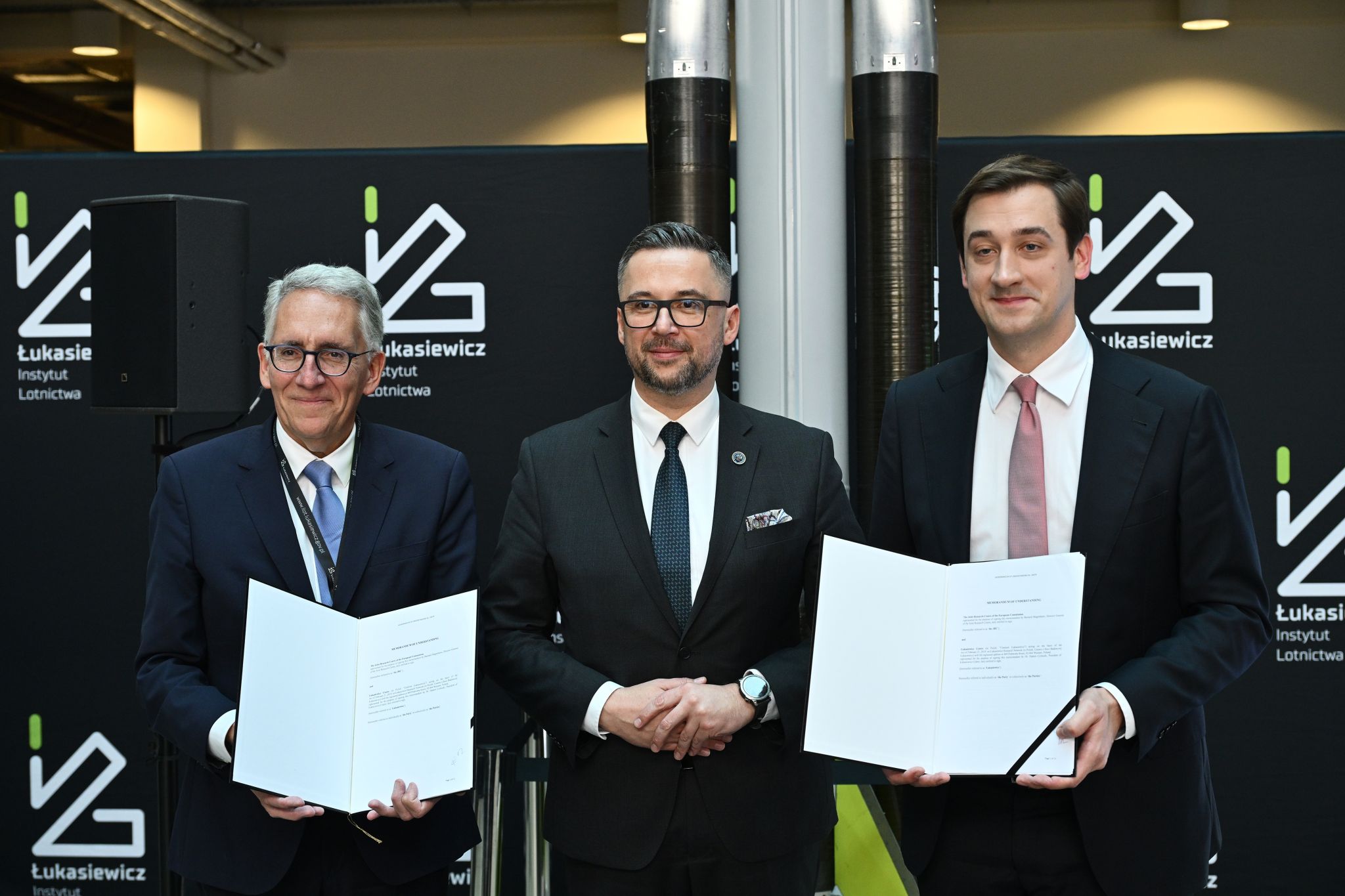
On 17 October, a Memorandum of Understanding was signed between the Łukasiewicz Research Network and the Joint Research Centre (JRC) of the European Commission.
Minister of Science and Higher Education, Dr Marcin Kulasek opened the ceremony. In his presence, the document was signed by the Director-General of the JRC, Bernard Magenhann, and the President of the Łukasiewicz Centre, Dr Hubert Cichocki.
Minister of Science: Łukasiewicz brings solutions for industry to Europe
‘Our country is becoming an integral and important part of the most significant scientific and research hub in united Europe,’ commented Minister Kulasek.
‘This agreement is our key to top-class European laboratories and modern research infrastructure. The Łukasiewicz Research Network brings solutions which truly serve the industries to this agreement. Our facilities are open to the needs of entrepreneurs and start-ups,’ assured the representative of the Polish government.
This event opens a new chapter in the strategic partnership, which is intended to strengthen cooperation between the Polish research and innovation sector and the European scientific community. Łukasiewicz is the first Polish institution to cooperate with the JRC on such a large scale.
JRC Director: Pooling resources and creating synergies is the only way forward
Joint Research Centre is one of the directorates of the European Commission. It carries out research that forms the basis for future EC acts. The JRC’s tasks also include providing independent scientific and technical analysis, supporting evidence-based public policy-making, and monitoring and evaluating its impact.
‘The JRC firmly believes that partnerships are crucial for the advancement of science and ensure that EU policy is based on scientific evidence. By joining forces, we can leverage our collective expertise, resources and experience to achieve results that have a greater impact and are more relevant to society,’ says Bernard Magenhann, Director-General of the JRC.
“Today, with all Member States facing increasing pressure on their national budgets, cooperation is even more important. Pooling resources and creating synergies is the only way forward. That is why the JRC seeks to assist Member States in their efforts and create added value through cooperation,” says Magenhann, assessing the role of the agreement in the context of the future of the EU.
Łukasiewicz Centre: This is an opportunity to increase Europe’s competitiveness through technology
The institutions will jointly implement research and development projects, support the development of scientific competences and carry out activities promoting Polish innovation and technology on the international stage. The partnership will strengthen knowledge transfer, increase the competitiveness of the European R&D sector and open up further opportunities for cooperation.
‘The combination of the scientific, expert and organisational potential of our teams will not only allow for the exchange of knowledge, but above all for the creation of new solutions that will have a real impact on the shape of European science and technology policy. This is not just a formal administrative act,’ notes Dr Hubert Cichocki, President of the Łukasiewicz Centre. ‘Above all, it is an expression of a shared ambition to increase the competitiveness of the European economy in the field of technology,’ he adds.
‘I believe that the agreement will be a lasting impetus for joint action towards the sovereignty of value chains in Europe,’ concludes Dr Cichocki.
Polish scientists in JRC laboratories
In addition to increasing the international visibility of Polish science and Poland’s participation in EU policy-making, formalising cooperation also has specific significance for individual Łukasiewicz research and implementation teams. Employees will gain access to JRC laboratories.
“Cooperation with the JRC opens up new opportunities for the Network to carry out joint projects, exchange knowledge and access unique research infrastructure,” says Prof. Rafał Łukasik, Director of the Department of Research, Innovation and Commercialisation at the Łukasiewicz Centre, responsible for international relations at the organisation.
‘Part of the potential has already been defined thanks to a visit to the JRC Ispra facility in Italy. Further potential will be developed thanks to planned delegations to JRC Petten and JRC Geel,’ announced Prof. Łukasik. The visits are to take place this year and in 2026.
Signing of the Memorandum of Understanding aligns with Łukasiewicz Research Network’s first strategy, adopted in January 2025. It provides for activities aimed at developing the innovation ecosystem in Poland and Europe, supporting national development strategies based on knowledge, technology and international cooperation.