Authors
Longina Madej-Kiełbik, Dorota Zielińska, Maria Wiśniewska-Wrona, Monika Sikora, Karolina Gzyra-Jagieła Wiesław Adamiec, Piotr Cichacz
Łukasiewicz – Łódź Institute of Technology, email to the corresponding authors: longina.madej-kielbik@lit.lukasiewicz.gov.pl, dorota.zielinska@lit.lukasiewicz.gov.pl
Aim of the project
The main objective was the design, manufacture and implementation of a set of dressings intended to protect injuries sustained during the performance of official duties by officers subordinate to the Minister of Interior and Administration, as well as soldiers of the Polish Armed Forces.
Short description of the problem addressed by this project
Haemorrhage is a leading cause of fatalities on the battlefield, accounting for more than 90% of potentially survivable pre-hospital deaths. An analysis of literature data on the cause of death on the battlefield showed that more than 80% of fatalities are caused by haemorrhage. A significant proportion of the injured are salvageable. Therefore, the project No. DOB-BIO6/19/98/2014 has taken steps to develop a dressing material for use on the battlefield by the uniformed officers.
The haemostatic factor has several innovative features that facilitate its effectiveness. Firstly, it increases the surface contact with the morphotic blood constituents, which activates the haemostatic pathway. Secondly, it promotes the aggregation of blood platelets by imparting a positive charge. Finally, it improves the absorption capacity, which indirectly affects the concentration of natural haemostatic factors, thereby enhancing the natural activation of the haemostatic pathway.
Main results and achievements
The project designed, manufactured and tested two types of haemostatic dressings
– haemostatic dressing,
– haemostatic compression dressing.
The prepared materials were tested to evaluate such properties as:
– surface density;
– water vapor transmission rate (MVTR);
– absorption during free soaking;
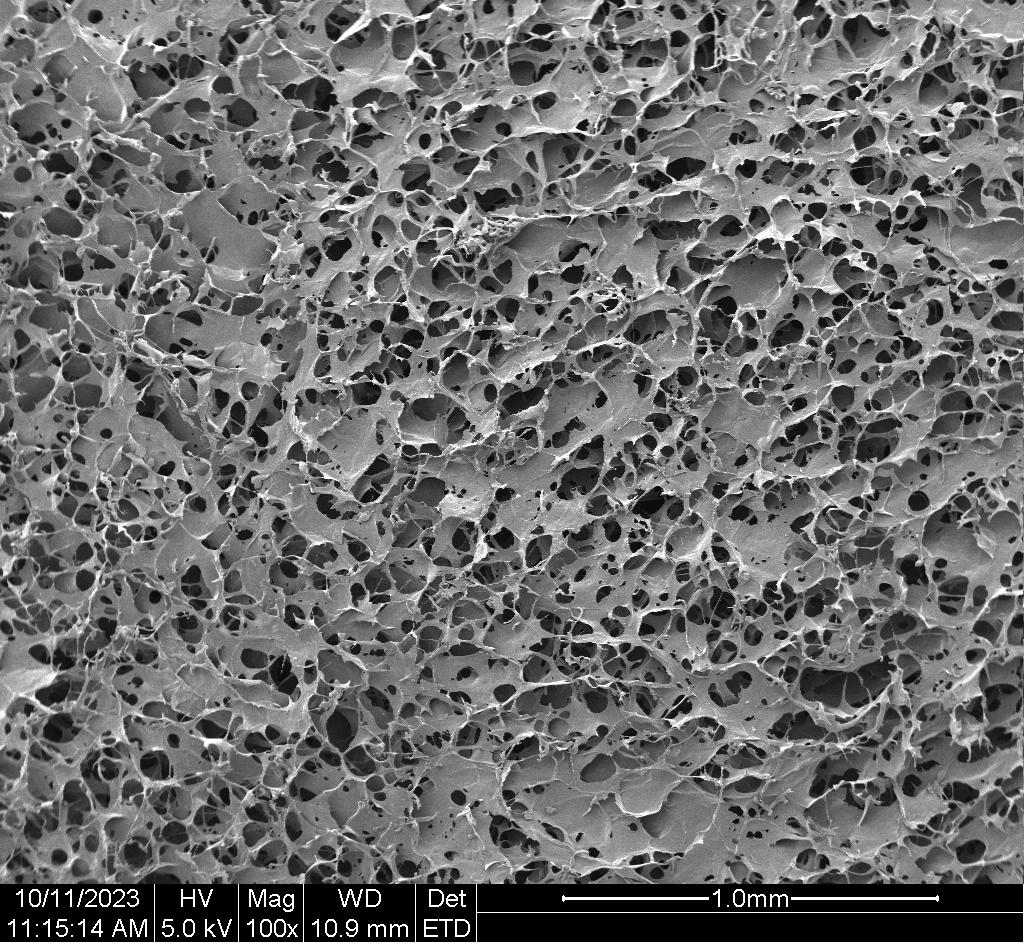
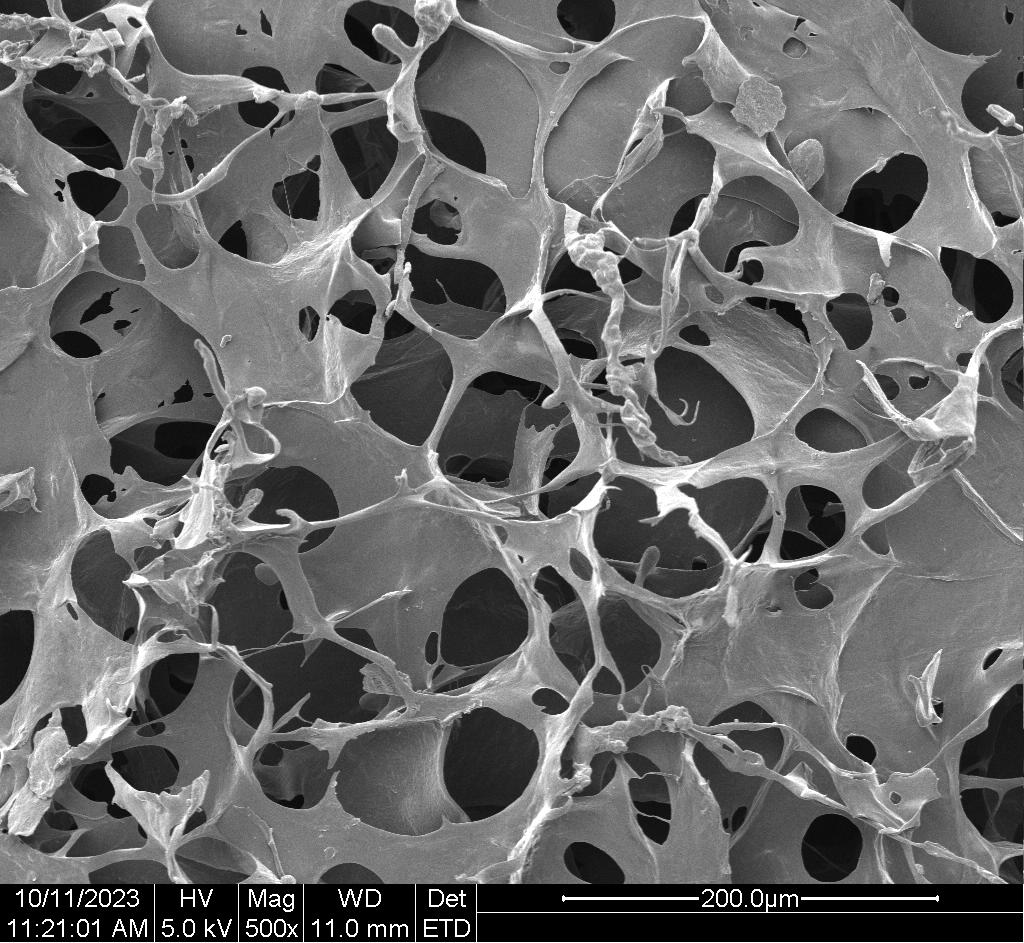
– topography.
Within the framework of the project, Lukasiewicz–ŁIT developed a polymer complex produced using natural polymers, chitosan and sodium-calcium alginate, the manufacturing technology of which is protected by patents PL 214 380 and PL 214 380. The manufactured complex was used in the production of haemostatic and compression-haemostatic dressing manufactured within the scope of the project.
Conclusion
Newly designed usable forms for topical haemostatic agents that were made from the suspension of the complex of micro- and nano-fibrils of chitosan/(calcium/sodium) alginate demonstrated high performance in the application of surgical interventions, medical first aid in the case of massive bleeding, bleeding resulting from multiple defects, combat injuries, and in patients with haemostasis problems. Both forms of the product are highly absorbent, which indirectly supports the process of haemostasis and MVTR. Furthermore, the accelerated ageing study allows for estimating the stability of the topical agents during storage and transportation.
Acknowledgments
The research was supported by the National Science Centre for Research and Development under the research project No. DOB-BIO6/19/98/2014 “Dressing set for protecting the injuries which can occur in the line of duty of uniformed officers”.