Authors
- Sieć Badawcza Łukasiewicz – Instytut Mikroelektroniki i Fotoniki
Dr inż. Kamil Pierściński, Lider GB Fotonika Podczerwieni, kamil.pierscinski@imif.lukasiewicz.gov.pl
Prof. Maciej Bugajski, - Airoptic Sp. z o.o.
dr Paweł Kluczyński, Prezes zarządu, info@airoptic.pl - Politechnika Wrocławska (Wydział Elektroniki Mikrosystemów i Fotoniki), Prof. Marek Tłaczała
Politechnika Wrocławska (Wydział Podstawowych Problemów Techniki), Prof. Grzegorz Sęk
Politechnika Rzeszowska (Wydział Elektrotechniki i Informatyki), Prof. Andrzej Kolek
Aim of the project
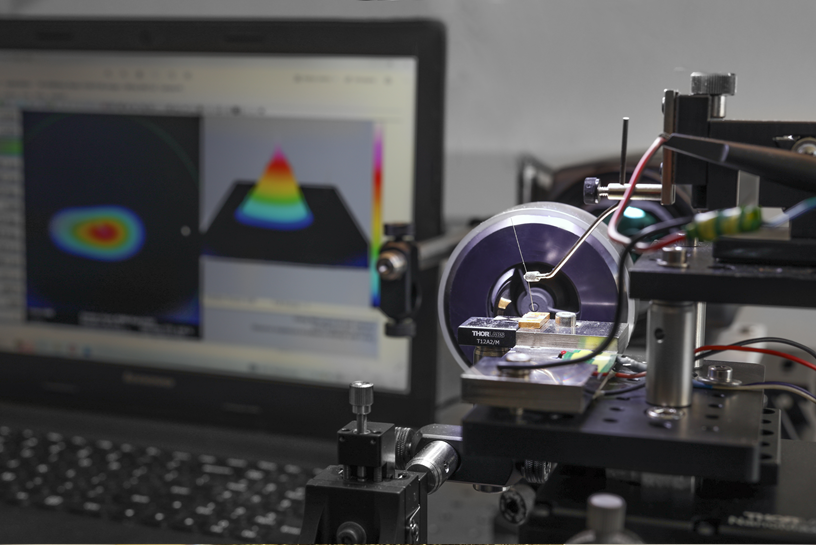
The project goal is to develop technology of single-mode quantum cascade lasers and demonstrate their use in real time gas sensing applications. In the recent years, significant improvement has been made in the development of efficient high power QCLs. These efforts have led to lasers with CW output power in excess of 1W and wall-plug efficiency greater than 10% at RT. However, in many of the commercial applications, e.g. gas sensing in the mid-infrared range, which contains strong molecular absorption lines of interest, optical powers of few tens of mWs are sufficient.
Therefore, the minimization of the power dissipation in the light sources becomes crucial. These lasers can enable the development of portable laser spectrometers operating at mid-infrared wavelengths for detection of compounds in atmospheric science, environmental monitoring, and other sensing applications. In the present project, we will focus on
the development of low power consumption single mode QCLs for application specified wavelengths from 4 to 12 μm range. Under the proposed project we will explore new schemes of gas detection, based on quantum cascade lasers. We plan to focus our research on longer wavelength range of the mid-infrared (at the second atmospheric window), because this area is still insufficiently studied, but it is also significantly more challenging from the point of view of basic research.
Short description of the problem, which this project addresses
Accurate gas analysis is critical across many disciplines. Manufacturing plants need to monitor gases handled within their factories and produced by their processes for both safety and process control purposes.
Environmental scientists detect and identify gaseous pollutants and toxins during site remediation and after hazmat incidents QCL technology provides for highly sensitive, high quality spectral measurements across the mid-infrared fingerprint region and rapid detection times with a compact and potentially hand-held form factor.
Because the QCL is an extremely bright, highly collimated laser beam, it is equally amenable to small volume multipass absorption cells as well as long distance open path measurements.
Under the proposed project we will explore new schemes of gas detection, based on quantum cascade lasers.
Main results and achievements
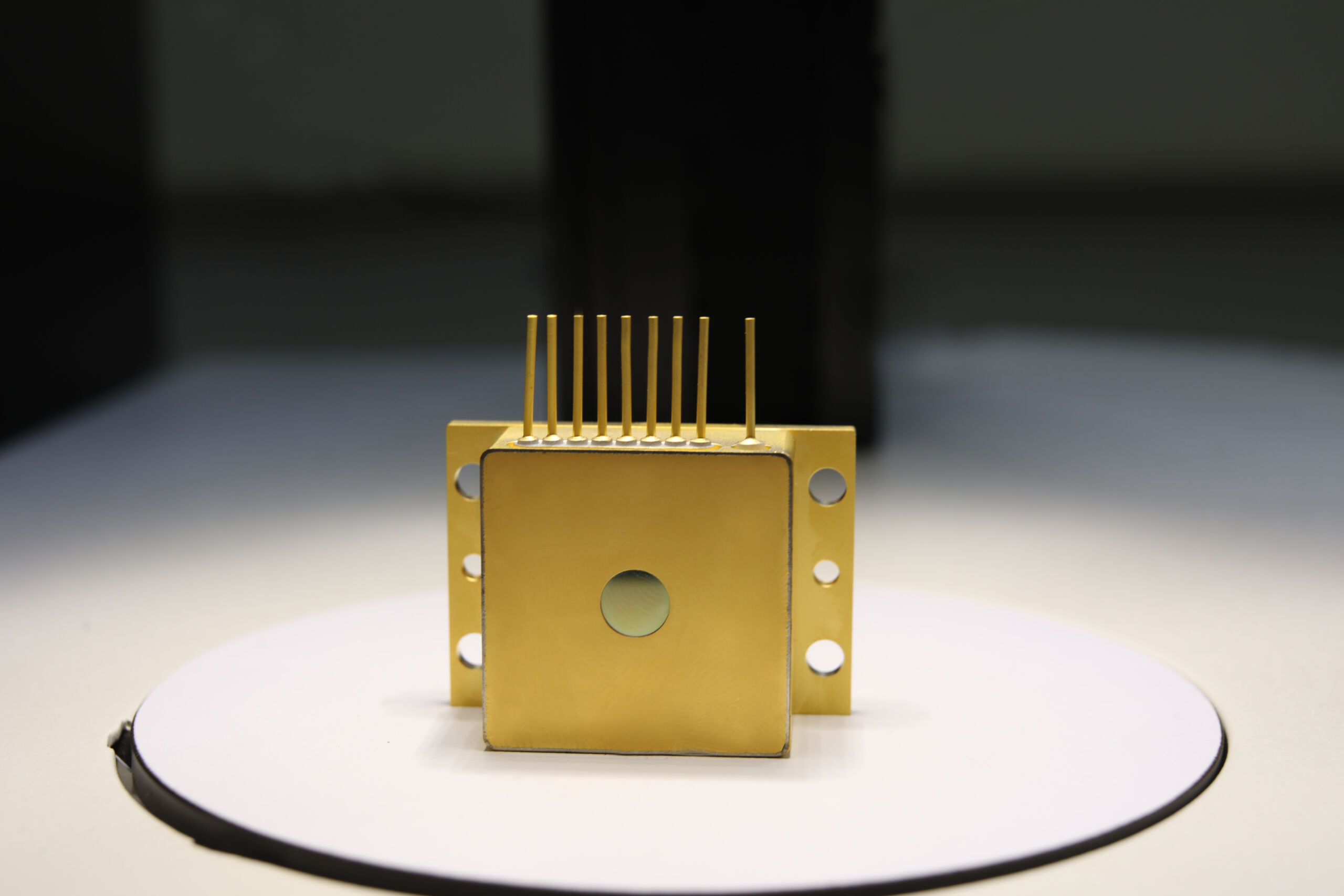
The project delivered two main products, which are the technology of material from which Quantum Cascade Lasers will be fabricated and QC laser-based multi-gas, multi-laser spectrometer, based on fabricated during the project QCLs.
Thanks to the Project, a series of technologies have been developed, among which the direct application in economic activity is held by single-mode DFB lasers in the 5.2-micrometer range and a gas spectrometer utilizing them for gas detection at the ppb level. The complementary developed technologies are crucial for the development of the knowledge base and enable further development of solutions implemented into economic activity.
As a result of the Project’s work, cascade laser manufacturing technology has been developed, enabling inclusion in the group of countries with a high level of technological development, where similar technologies have already been developed. Thanks to access to national components, Airoptic can offer a more competitive product and reduce production costs. Greater profit can be allocated to further company development, thus leading to the development of new innovative products utilizing national components. An additional benefit of access to the developed technology is the independence from foreign technology suppliers.
Thanks to the success achieved in the project, it is possible to introduce the developed solutions into the economic activity of both Airoptic and Łukasiewicz – IMIF. Cascade laser manufacturing requires highly specialized equipment and infrastructure; therefore, to achieve financial goals (feasibility of implementation), small-scale production of components for use in gas analysis systems utilizing Łukasiewicz – IMIF infrastructure should be initiated.
Conclusions
The results achieved within the project significantly developed the research and scientific discipline. We examined not only a new type of quantum cascade lasers (voltage-tunable) and new methods of optical gas sensing but also broadened our knowledge of the basic physics that governs the operation of such lasers. As a result, a new class of quantum cascade lasers may have appeared along with their new applications. This, in turn, has had an economic and social impact. The knowledge gathered was very useful for further development of the partners cooperating in the project, and enhanced their position at the national level and even internationally. Cooperation in the framework of the project brought closer research institutions and small technology companies. In the longer term, this could lead to the development of quantum cascade laser technology and its applications. The cooperation connected three different regions of Poland and could also have become the beginning of their intensified technological development.
The results of the project significantly developed the research field and scientific discipline.
Acknowledgment
The results of the project significantly developed the research field and scientific discipline. The consortium that executed the project, through the combined forces of the five institutions (Łukasiewicz – IMIF, Wrocław University of Technology, Military University of Technology, Rzeszów University of Technology, Airoptic), presented research capabilities far unique at the national level, but also quite original internationally. Perfectly complementary expertise and resources of the project partners gave a realistic chance of success and significant impact on the development of the related fields of research.