Authors
Katarzyna Gańczyk-Specjalska, Łukasiewicz Research Network – Institute of Industrial Organic Chemistry, katarzyna.ganczyk-specjalska@ipo.lukasiewicz.gov.pl
Rafał Bogusz, Łukasiewicz Research Network – Institute of Industrial Organic Chemistry
Paulina Paziewska, Łukasiewicz Research Network – Institute of Industrial Organic Chemistry
Rafał Lewczuk, Łukasiewicz Research Network – Institute of Industrial Organic Chemistry
Aim of the project
The project aims to develop the composition and production technology of high-performance rockets.
Propellants that emit less corrosive and toxic gas products during combustion. The developed fuels are characterized by lower hydrogen chloride emission in combustion products than conventional rocket fuels containing ammonium perchlorate. Majority of solid heterogeneous rocket propellants contain ammonium perchlorate responsible for the formation of hydrogen chloride in the combustion products. The project’s main aim was to develop the composition of eco-friendly solid heterogeneous rocket fuel, determine the characteristics of the propellant model, and develop the technological process of its production (possibly carried out by Polish military production companies). Additionally, the developed propellants must have excellent ballistic parameters (high burning rate) to be used in gas dynamic control actuator systems in rockets.
Short description of the problem addressed by this project
The main component in solid heterogeneous rocket propellants is the oxidizer. The compound most commonly chosen for this function is ammonium perchlorate. During the operation of a rocket engine, the burning fuel emits various types of gaseous products. The use of ammonium perchlorate produces hydrogen chloride that is present in the combustion products. Hydrogen chloride is responsible for forming a white streak behind the flying missile and has a corrosive effect on the launcher components. However, ammonium perchlorate is still used in fuels due to the excellent performance parameters of the final products. The emission rate of hydrogen chloride can be reduced by replacing or eliminating ammonium perchlorate in rocket fuels or by using neutralizing compounds that react with the released hydrogen chloride. About 50 compositions of solid heterogeneous rocket propellants were studied during the project, taking into account such substances as polymers, crosslinking agents, plasticizers, oxidizers, combustible components, high-energy compounds, burning rate modifiers and neutralizing compounds. Combustion products were classified either as primary or secondary smoke to classify solid rocket fuels according to the AGARD standard. Primary smokes include all solid products formed during combustion (aluminum oxide). Secondary smokes include condensable gases, i.e., hydrogen chloride, fluoride, potassium hydroxide, and water vapour.
Main results and achievements
The prototype of an environmentally friendly propellant was obtained and can be applied in the executive control system of a gas-dynamic missile. The developed prototype is characterized by a linear burning rate of more than 40 mm/s in the pressure range from 30 to 40 MPa.
Knowledge of the formation of solid heterogeneous rocket propellants with reduced emissivity of primary and secondary smokes has been expanded, and the necessary experience has been gained. The selected compositions of ‘green’ propellants were characterized by a reduced amount of HCl in the products of combustion by min. 73% relative to the classical ammonium perchlorate-based propellant composition.
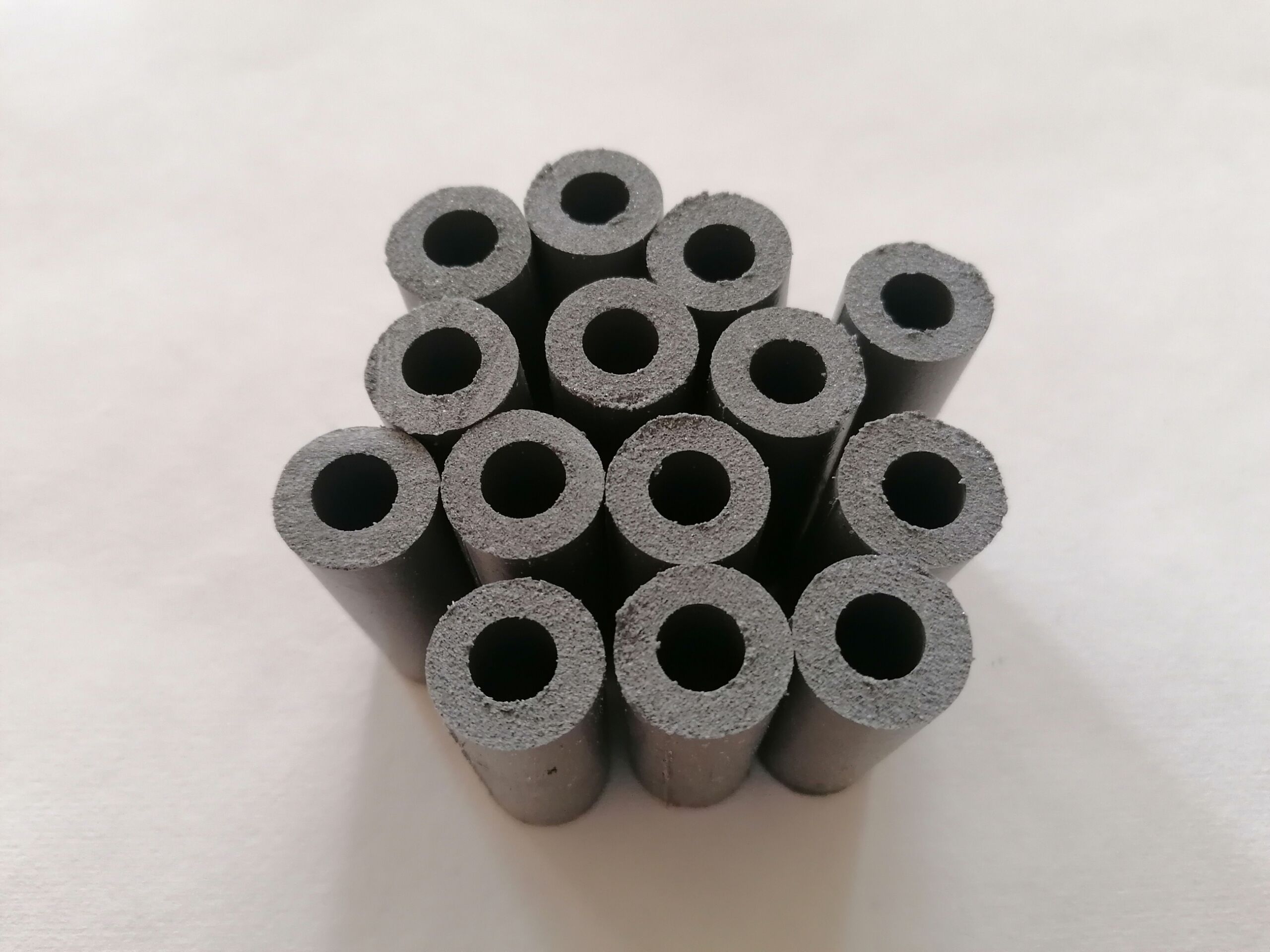
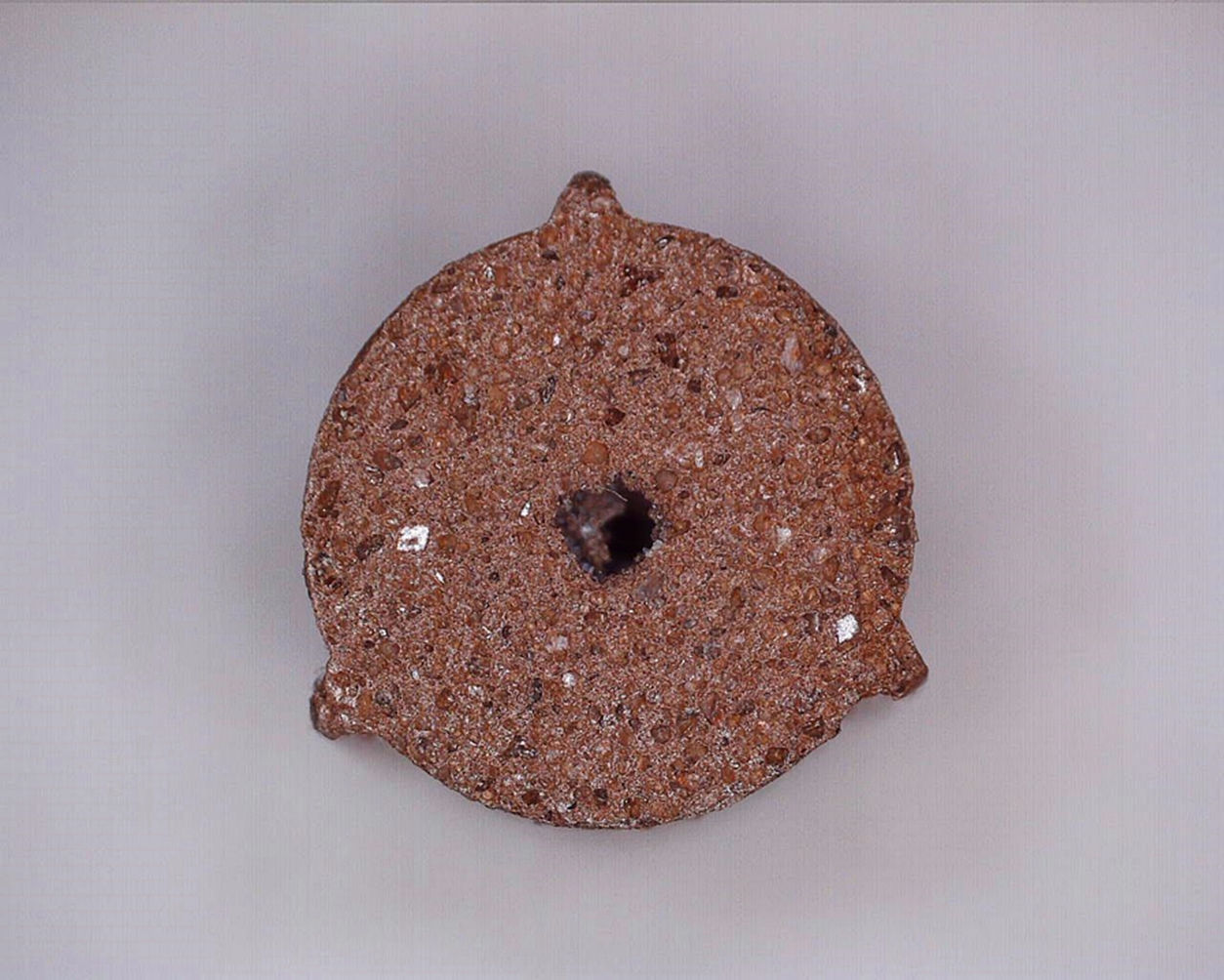
Another result of the completed work is the development of two methods for forming small-size propellant charges (casting and pressing methods). Both methods were successfully used to obtain a propulsion charge with a compact structure and no significant defects visible on the outer surface.
As a result of the project, two inventions were submitted to the Patent Office of the Republic of Poland: “Solid heterogeneous rocket propellants with reduced emission of hydrogen chloride in combustion products” (application with registration number P.442263) and “Formation of solid heterogeneous rocket propellant by pressing” (application with registration number P.442272).
Conclusion
As a result of the project, a prototype of a heterogeneous solid fuel at the VI level of technological readiness was developed, along with appropriate technical documentation regarding operational parameters and production technology. The developed technology offers an increase in the usability of commonly utilized heterogeneous solid rocket propellants. The developed propellants guarantee an increase in the burning rate by over 400% compared to the rocket propellants currently used in sustainer charges. This procedure allows for the extension of the range of missiles while reducing the possibility of interception. The use of neutralizing additives in the propellant composition provides for the reduction of the missile’s trail, reducing the chance of detecting the launcher’s position. At the same time, reduction of the hydrogen chloride emissions limits the corrosive degradation of the launcher itself. The technology can be implemented into missiles using solid heterogeneous rocket propellants in rocket engines (GROM, PIORUN, FENIKS).
Acknowledgments
This research was funded by The National Centre for Research and Development under the scientific research program for National Defense and Security, “Future Technologies for Defense – Young Scientists Competition,” grant number DOB-2P/03/01/2018.