Authors
Grzegorz Trzeciak
Unmanned Technologies Center Director
Łukasiewicz Research Network – Institute of Aviation
info@ilot.lukasiewicz.gov.pl
Aim of the project
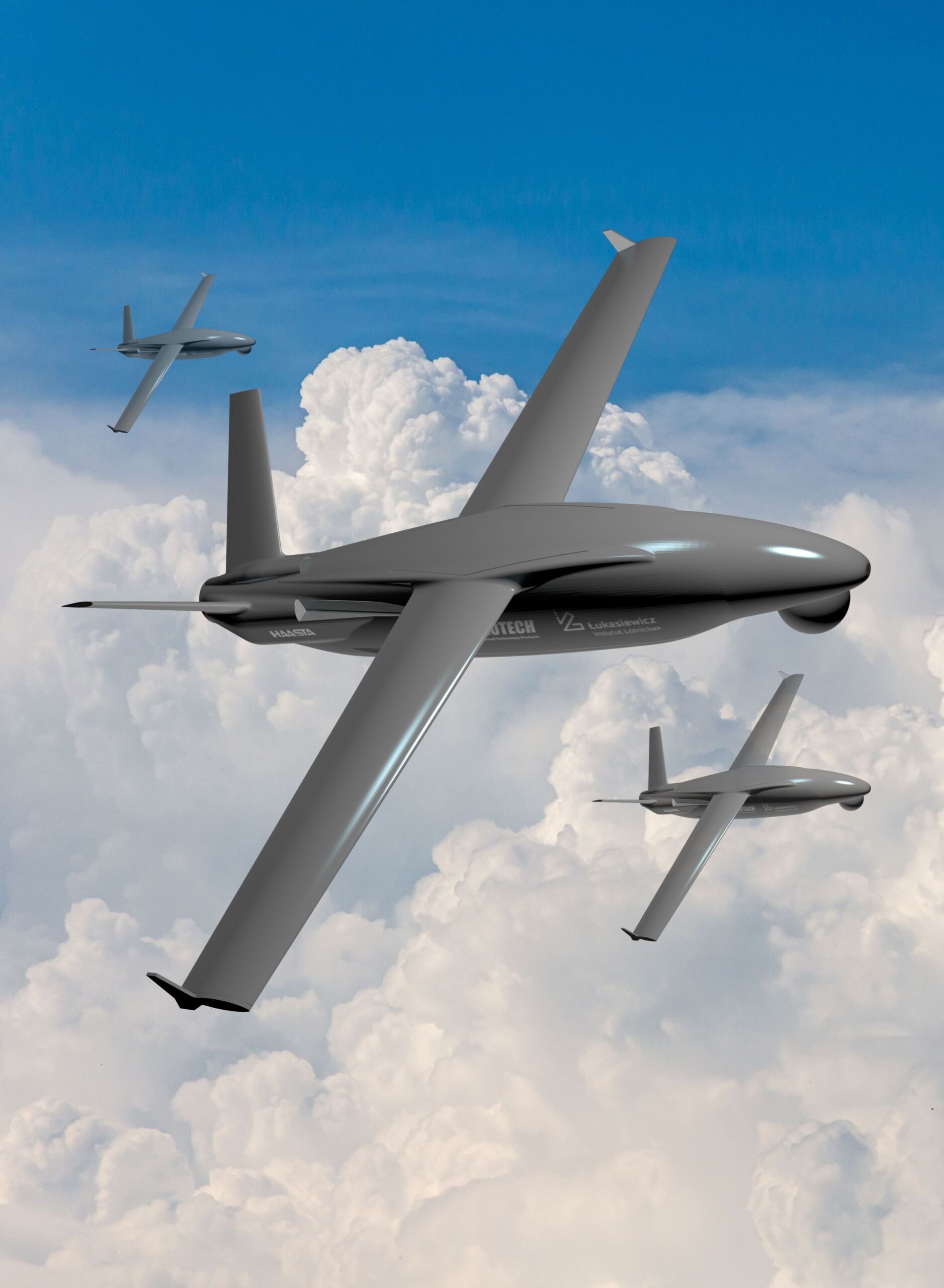
The design, developed in collaboration with Eurotech company, draws upon insights gained from recent years of combat operations and wars. It has been meticulously crafted to address the demands of the battlefield and is aligned with the guidelines outlined in STANAG 4703. The array of payloads it accommodates facilitates diverse flight configurations while upholding robust operational prowess and the capacity to navigate challenging weather conditions.
In military applications, the system is designed to penetrate air defenses, operate deep within opponent territory, and perform reconnaissance or air-diversion tasks. The system can also be used in a swarm to confuse anti-aircraft defense systems.
Civilian applications – monitoring long stretches of linear infrastructure.
Short description of the problem, which this project addresses
Innovative hybrid-power UAV system for surveillance, cargo transportation, photogrammetry, long-range reconnaissance, diversion and other applications.
Thanks to its upgradeability, the system can be configured for a variety of missions, both civilian and military. The aircraft’s speed makes it a good platform for small but high-value cargo flights.
The system is mature and represents a class of tactical UAV systems.
Main results and achievements
Payload up to 30 kg (depending on configuration). Operation is independent of airport infrastructure: launch from an air launcher, landing on a skid, or gliding parachute. Small RCS radar reflectivity footprint, low IR signature due to the enclosed propulsion system, and high piston engine efficiency. Mobile Ground Control Station (NSK/GCS). Various range of payloads allows adaptation to diverse mission. Swarm fights applications.
Additionally, HAASTA is also a technology demonstrator for modern solutions designed at Lukasiewicz—ILOT, including acoustically optimized propellers, thermoplastic housings that reflect electromagnetic radiation, and aerodynamic optimization.
Conclusion
The project has allowed entry into the medium-sized unmanned aircraft market segment. It opened the possibility of modifying the system for a range of missions, both civilian and military. The project has opened the way for developing an unmanned fighter aircraft, a completely new quality on the battlefield. The system is being included in the process of satellite navigation testing. It is also planned to be used in a project using UAVs for the delivery of High-Value Low-Volume goods.
Acknowledgements
Special thanks to the entire team involved in the project for their help with its implementation.
Thanks to the research team preparing the project from the aviation side.
Special thanks to the support teams, i.e., legal, commercialization, and financial departments.